Case study 01 · Holt Law
Building the systems behind 100+ concurrent licensing projects
- Scope
- 100+ concurrent projects, about 300 client engagements taken to completion, and new practice areas
- My role
- Program Manager & Senior Paralegal
- Team
- Six-person legal support team, three direct reports, plus attorneys, operations, and sales and intake
- Timeframe
- Feb 2024 to Sep 2026
- Outcome
- Met the 10% client application return-rate target
In short
Holt Law was a growing healthcare law firm where very few processes were documented. I built the systems that let it scale: SOPs and workflows for every practice area, KPIs for the team, a training path for new hires, and a repeatable way to launch new practice areas. The team became independent, my direct reports grew significantly in skill and confidence, and we met the firm's 10% target for returned applications.
The situation
What was at stake
Holt Law helps healthcare providers start their businesses and get licensed. That means forming the organization, completing state and federal filings, writing the required policies, and securing the license. At any given time, more than 100 licensing projects were in progress at once.
When I stepped into the lead role, the work depended on what a few experienced people remembered. There were very few SOPs, no clear handoffs between roles, and no KPIs. That made new hires slow to train at the moment the team most needed to learn quickly. We were managing a heavy workload while trying to set both the team and our clients up for success.
My role
What I owned
I owned delivery for all of the firm's state and federal healthcare licensing practice areas, about ten at a time, as we opened and closed areas based on client demand and value to the firm.
Project delivery
I started by running every process myself: reviewing each new client's goals, leading kickoff calls, and checking the work at every stage before it went to the agency or the attorneys. Once I knew each process inside and out, I turned it into SOPs and, with operations, built the workflows in our project management system. With those systems in place, I trained the team and handed off the day-to-day work. My role grew into managing every workflow across our practice areas, quality-checking each stage, and keeping every project on track.
Team leadership
I led a six-person legal support team with three direct reports. I designed the training and balanced workloads. I was responsible for hiring for the legal support team: identifying staffing needs, making the case for each new role to leadership, and conducting first-round interviews.
Practice development
I developed new service offerings, defining the steps, what was in and out of scope, and the price, with final sign-off from the lead attorney. I also assessed how each practice area was performing and made the case to retire those that no longer served the firm or its clients.
What I did
Key decisions
Document the busiest work first
I created SOPs for every licensing practice area the firm offered, starting where the pressure was highest. Adult Rehabilitative Mental Health Services (ARMHS) licensing had strong client demand and was the hardest area to train people on. Finding time to write it on top of a heavy workload was a challenge. Once it was complete, the knowledge no longer depended on one person. New team members could learn the work directly from the SOP.
One workflow, visible to everyone
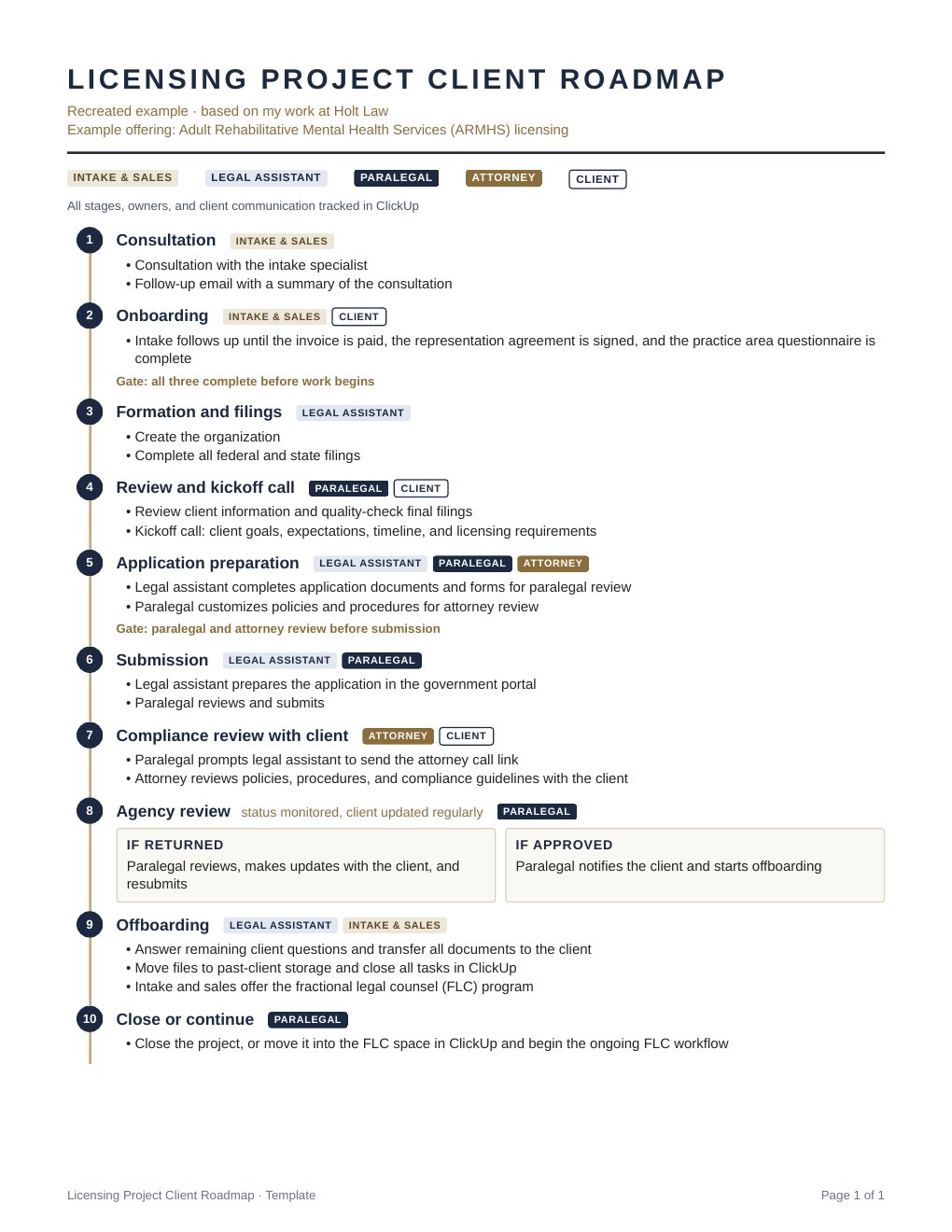
Together with the operations team, we designed the full client workflow, from what clients see during onboarding to each handoff on our side, with automations at every stage. Every project lived in ClickUp, showing its stage, the task owner, the timeline, and every client conversation. Nothing depended on memory, and work didn't fall through the cracks.
Measures the team could see
With no KPIs in place, I partnered with leadership to define them for each practice area and each team member, including application return rates and time spent in each project stage. Reviewing them together gave people clear data on their own progress.
A repeatable way to launch new practice areas
When intake saw demand for a new type of license, I researched the requirements, outlined the full offering from onboarding to approval, wrote the SOP, and set up the workflow with operations. I piloted each new offering with the first client myself, refined it based on what I learned, and trained the team to deliver it. Each launch ended with a lessons-learned review that shaped the next one.
The clearest example was Early Intensive Developmental and Behavioral Intervention (EIDBI) licensing, a new state requirement for providers of autism spectrum disorder treatment and services. As one of very few law firms offering this service, we opened a niche that was high volume and high value for the firm, and especially valuable to the providers we served.
Training toward ownership
For their first three months, I worked closely with each new hire and reviewed their work in detail. After that, the goal was independence. I stepped back so they could own their projects, even when that meant learning from a returned application. Daily check-ins, weekly one-on-ones, and weekly L10 team meetings helped us catch problems early.
I also monitored team capacity closely. When people were stretched too thin, I brought it to leadership's attention and advocated for the team. I built the kind of trust where they felt comfortable bringing me their questions and concerns.
Under pressure
When the plan met reality
Later in my time at Holt Law, licensing regulations began changing quickly, often without notice. Requirements shifted, government timelines stretched, and applications came back for reasons no one had been told about.
- I updated our offerings to meet each new requirement and kept the team aligned as the rules changed.
- I managed client expectations through each change, delivering hard news clearly and always with a plan to move forward. We didn't take blame for changes outside our control, and we never left a client without a next step.
- When projects stalled, I advocated directly with the state agency to move them forward.
Work sample
The client roadmap
The outcome
What changed
- Quality: Before the regulatory changes, we met the firm's target of under 10% of licensing applications returned, and time in each project stage stayed within a 10% variance.
- A team that ran without me: The team grew confident enough to lead client communication themselves. I moved from doing client work to overseeing the full portfolio and stepping in when needed.
- Growth for people: My three direct reports grew significantly in skill and confidence and consistently hit their metrics.
- Easier hiring: With SOPs and workflows in place, hiring and training new staff became much easier.
- Lasting client relationships: Clients I worked with moved into the firm's fractional legal counsel program, an ongoing monthly relationship.
- Time saved: Standard AI prompts and workflows built on top of the SOPs cut the time spent on research and repetitive tasks. See case study 03.
What I'd do differently
Looking back
I'd set clearer scope boundaries with clients from the start, especially around what we couldn't control in a changing regulatory landscape. Defining what's in and out of scope early protects the team and still keeps clients satisfied. Over time, setting those boundaries became one of my real strengths.
I'd also delegate sooner. Handing off more work earlier would have given team members experience faster, kept my own workload sustainable, and freed me to build and roll out our systems more quickly.