Case study 02 · Attention Driven Marketing
Building a commercial production process from zero
- Scope
- 20+ commercial shoots in about 20 cities, plus monthly video for 30+ client accounts
- My role
- Creative Production Manager
- Team
- Writers, leadership, videographer, four remote editors, actors and voice actors
- Timeframe
- Aug 2021 to Jan 2024
- Outcome
- Commercials became a growing offering, with several produced per shoot
In short
Attention Driven Marketing set out to produce its first commercials with no process to follow. Alongside leadership and the creative team, I helped turn ideas into shootable concepts. I then built the production process and organized everything needed to film: casting, locations, props, and a five-day shoot plan, often in cities I had never visited. Each shoot fed a full year of client content, produced on a standardized monthly schedule with four editors in three countries. Commercials became a growing part of the agency's work.
The situation
What was at stake
The agency produced monthly video and social content for more than 30 dental practices, then ran it as paid campaigns. Each practice had one shoot a year, and that footage had to last all twelve months.
When the agency decided to add commercials, it had no playbook to follow: no casting process, no way to source locations, and no plan for managing a shoot. Every shoot ran five to six days in the client's city on a fixed schedule, with no chance to scout locations or meet actors in advance.
My role
What I owned
I led production from concept development through final delivery.
Planning
I shaped concepts with the writers and leadership, then presented them to each client for approval before we traveled. I developed the shoot schedule and handled casting, voice talent, locations, props, and wardrobe. Each plan went to leadership for final approval, and I kept every shoot within the client's approved budget.
Post-production
Once we wrapped, I organized the shoot notes and footage and scheduled the month's work across four editors.
Delivery
Before editors finalized any video, I made sure the client was completely satisfied with it. I then handed the finished work to the campaign team and covered production in each client's monthly report.
Early on, I also routed every task across the team, from copy to thumbnails to campaigns. When the agency hired for that role, I moved to video production full time.
What I did
Key decisions
One checklist for every shoot
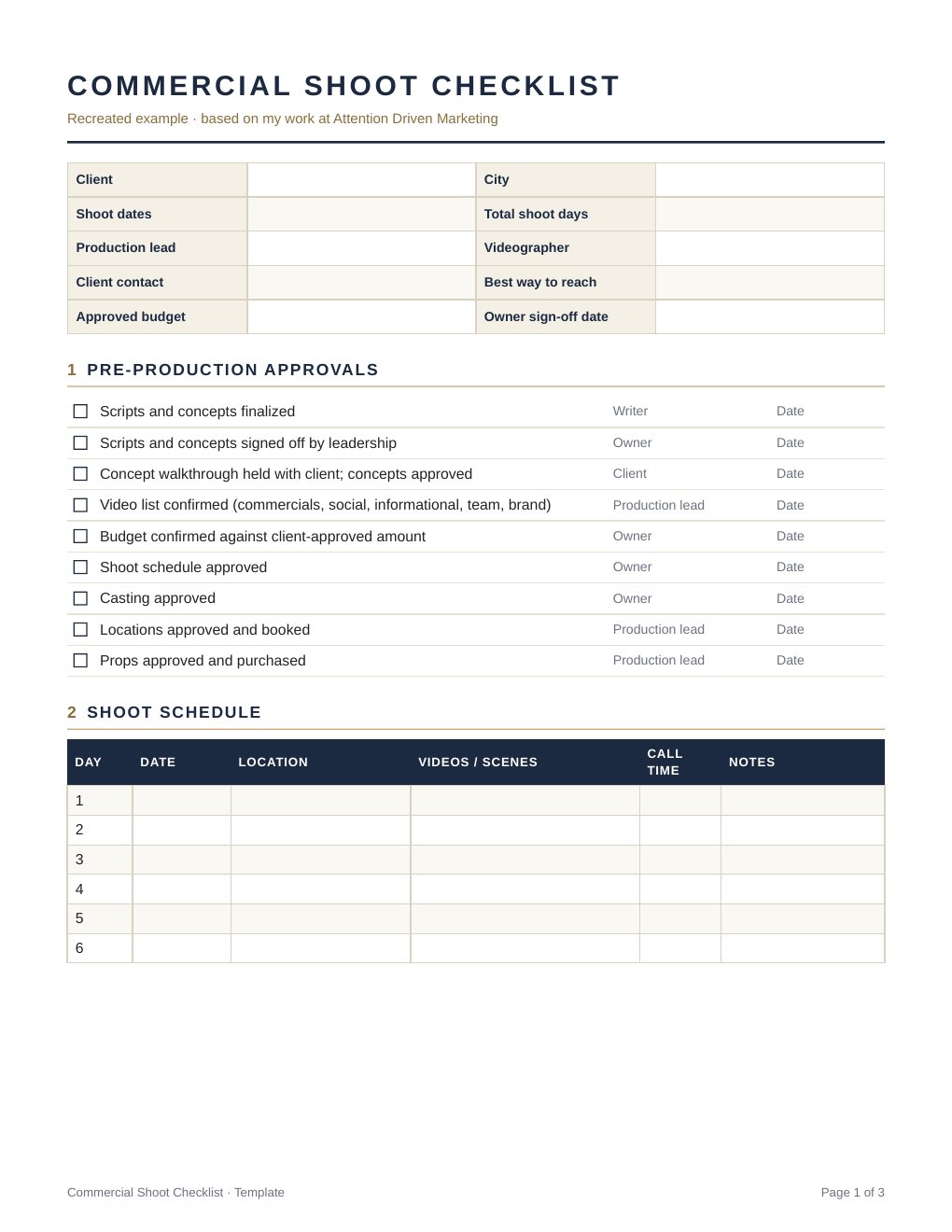
I turned each script into a single checklist of cast, locations, props, and wardrobe, agreed with the team before we left. The core format stayed consistent from shoot to shoot, and we tailored it to each client's scripts and locations. Every new city started from a tested plan instead of a blank page.
Casting from a distance
A national casting platform gave me a deep pool of actors in every city. I could cast without being there, and recast fast when I had to.
Client approval before travel
I walked each client through the concepts before the shoot, so scope and creative direction were agreed before the cameras came out.
Stakeholder communication that fit the person
Dental practices are busy, and approvals were slow. I learned which clients wanted regular reminders, which needed room, and when to go through someone else on their team. With editors working across three countries, misunderstandings could come from language or working style. I took the time to learn each editor's communication and working style, which helped us clear up misunderstandings quickly and build strong working relationships.
On set
When the plan met reality
Nothing was rehearsed. We arrived with the writers' scripts and a tight schedule, and adjusted on the spot when something didn't work. Working alongside leadership and our videographer, I kept the logistics moving:
- Recasting quickly when an actor wasn't right for the role.
- Buying new props when a storyline needed a different approach, while we adapted the script on set.
- Finding extra people or props when a scene called for more than we planned.
- Reworking the plan when the weather didn't cooperate.
We finished every shoot with the videos we needed, even when that meant improvising.
Work sample
The shoot checklist
The outcome
What changed
Commercials became a growing part of the agency's work. Over time, we went from one commercial per shoot to several. That took more planning, and it gave each client more high-quality content for the year ahead.
The commercials were written to be funny or genuinely moving, and clients loved them.
What I'd do differently
Looking back
I'd bring more structure to what we couldn't see in advance. Since we couldn't scout locations or meet actors before arriving, I would build a way to rehearse and test each shoot ahead of time: more time with actors before the shoot, and a scene-by-scene walkthrough of each script to confirm we had the props and setup it needed.
I'd also build on the standby actors and weather alternatives in the checklist with a full risk register for every shoot. It would cover risks like a location falling through, travel delays, equipment problems, and late client changes, each with a response planned in advance. After every shoot, I'd record lessons learned in one central file for the agency and review it before the next shoot, so improvements carried forward instead of living in memory.